

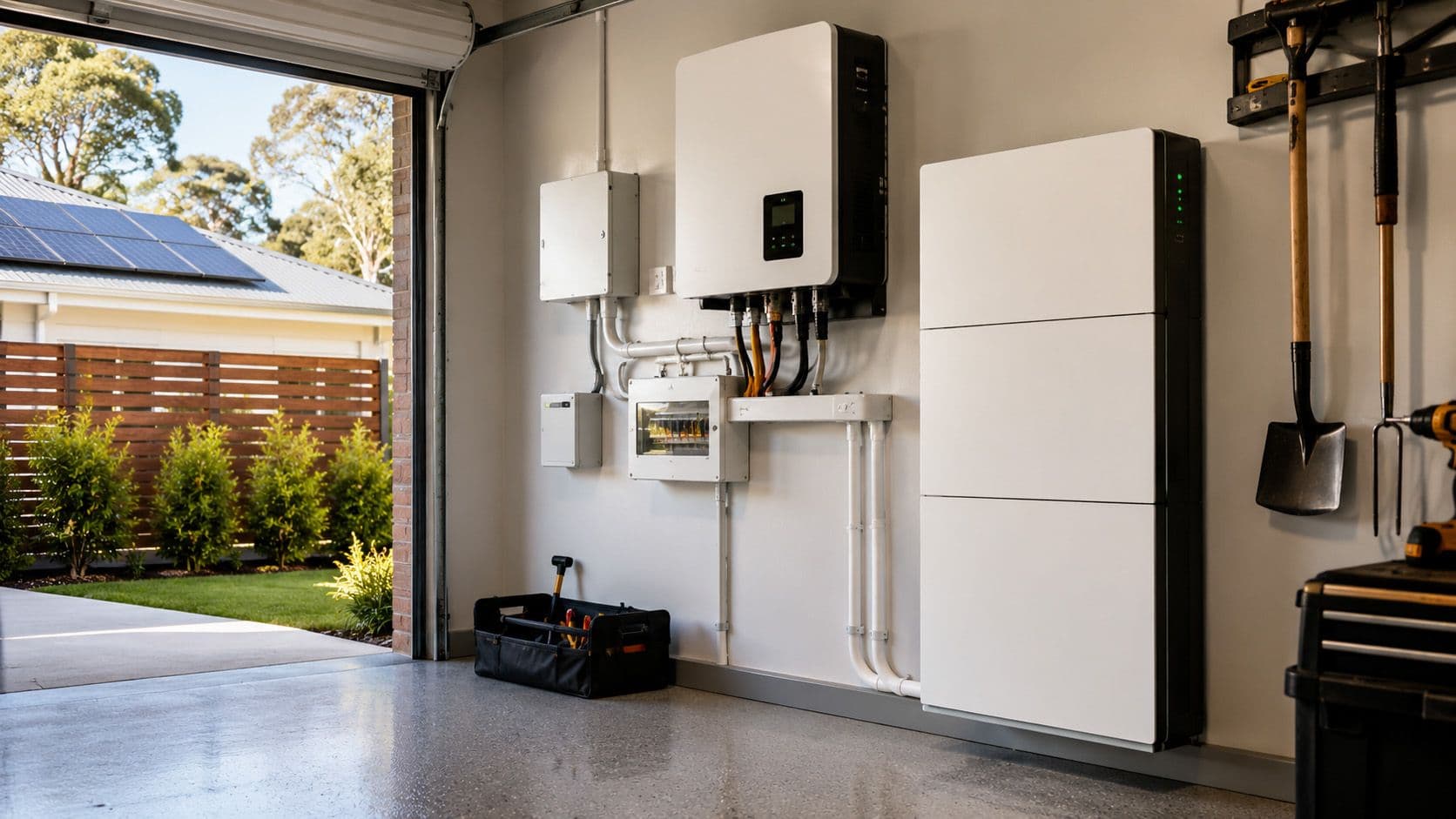
Key Takeaways
Solar battery prices vary significantly according to usable capacity, power output, product quality, warranty, and installation complexity.
Adding a battery to an existing solar system may require a compatible inverter, AC coupling, switchboard upgrades, or additional monitoring equipment.
A standard battery installation does not automatically provide power during an outage unless backup capability and suitable circuits are included.
A clear quote should separate the battery, inverter, backup hardware, electrical work, incentives, commissioning, monitoring, warranties, and exclusions.
Overview
Solar battery installation costs depend on usable storage capacity, battery chemistry, inverter compatibility, AC or DC coupling, backup-power requirements, switchboard condition, installation location, electrical work, monitoring, government incentives, and integration with an existing or new solar system.
1. Typical Solar Battery Installation Costs
Solar battery installation costs vary according to usable capacity, power output, product quality, inverter compatibility, backup capability, electrical work, installation location, and available incentives.
Small Home Battery System
$8,000 – $14,000
Approximately 5 to 10 kWh of usable storage with standard installation, compatible equipment, monitoring, and limited electrical upgrades.
Standard Home Battery System
$12,000 – $20,000
Approximately 10 to 15 kWh of usable storage with inverter integration, monitoring, installation, commissioning, and possible backup capability.
Large or Advanced Battery System
$18,000 – $30,000+
Higher storage capacity, three-phase integration, whole-home backup, premium equipment, switchboard work, additional circuits, or complex installation.
2. What Affects the Cost?
The main cost differences usually come from battery size, inverter requirements, backup configuration, switchboard condition, phase type, cable routes, mounting location, and system integration.
Battery Capacity & Output
Larger usable capacity and higher continuous or peak power output generally increase equipment costs.
Inverter Compatibility
Existing solar equipment may require AC coupling, a hybrid inverter, additional controllers, or replacement to support the battery.
Backup Power
Backup gateways, essential-load circuits, whole-home backup, black-start capability, and three-phase support can add substantial cost.
Electrical & Site Work
Switchboard upgrades, cable runs, mounting surfaces, bollards, fire-resistant barriers, weather protection, and restricted access affect installation costs.
3. Cost Breakdown
A solar battery quote commonly combines the battery, inverter or controller, backup hardware, mounting equipment, electrical work, installation labour, monitoring, commissioning, and compliance documentation.
Total
$16,000
Battery & Control Equipment
$9,600
60%
Inverter & Integration Hardware
$2,400
15%
Installation Labour
$1,600
10%
Switchboard & Electrical Work
$1,600
10%
Commissioning & Documentation
$800
5%
4. Battery Sizing, Backup Power and Incentives
The most suitable battery is determined by household energy use, solar generation, tariff structure, backup needs, and equipment compatibility.
Battery capacity should be compared using usable storage rather than nominal capacity alone. The quote should also specify continuous power, peak power, expected operating range, battery chemistry, cycle warranty, product warranty, monitoring features, and whether future expansion is supported.
Government discounts and state-based assistance can change the final customer price. Eligibility may depend on battery capacity, approved products, accredited installation, connection to rooftop solar, installation date, and program rules. The quote should show the price before incentives, the estimated discount, and the final payable amount separately.
5. Solar Battery Installation Quote Checks
Before accepting a solar battery quote, confirm the equipment specifications, system compatibility, backup arrangement, incentives, and electrical scope.
Confirm the battery model, usable capacity, power output, chemistry, inverter, monitoring platform, and warranty.
Ask whether backup hardware, essential-load circuits, switchboard upgrades, controllers, cabling, and mounting equipment are included.
Check whether three-phase integration, long cable runs, unsuitable mounting surfaces, network upgrades, or safety barriers are excluded.
Confirm that incentives, commissioning, grid applications, testing, monitoring setup, user training, and compliance documents are itemised.
7. Questions to Ask Before Installing a Solar Battery
Use these questions to compare solar battery quotes and avoid unexpected equipment, installation, or subscription costs.
Does the price include the battery, inverter, mounting equipment, electrical work, installation, commissioning, and documentation?
What usable capacity, continuous output, peak output, chemistry, monitoring features, and warranties are included?
Is the battery fully compatible with the existing solar inverter, switchboard, electricity supply, and phase configuration?
Will the battery provide power during an outage, and which circuits or appliances will remain operational?
Are switchboard upgrades, backup hardware, cabling, barriers, meter work, grid applications, and cleanup included?
What is the price before incentives, which discounts are included, and what conditions could change the final amount?
Not sure which guide fits your project?
Start a free cost check and FairScope AI will recommend the right report level for your project.
It only takes 2 minutes
2,500+
Reports Generated
98%
Customer Satisfaction
Australia
Market Focused
Secure & Private
Your data is protected